


There is a moment in every business when you realise that the problem in front of you is no longer technical, or logistical, or even financial.
It’s temporal.
Time starts slipping. Deadlines soften. Weeks blur. And before you realise it, the thing you are really losing isn’t margin or momentum — it’s trust.
This is a story about that moment.
Where this story actually begins
It doesn’t begin in 2022, but that’s when we felt the impact of what was happening. Our customers did too.
It begins a little earlier, when our original shoemaker unilaterally changed the construction of our handwelted shoes during the pandemic. He switched from our approved construction — considered the best method for this style — to gluing them with a faux welt. It was a considerably cheaper, easier process. Without telling us. Which meant we, in turn, were marketing and selling a false product.
We weren’t happy. Our customers weren’t happy. Three things happened in very short order.
We lost customer trust. We refunded — or offered compensation — for every pair of fraudulent shoes sold. And we walked away from Alessandro Cappi, the shoemaker at fault.
But nothing played out as we expected, even though we ensured every single customer was made whole. Once lost, consumer confidence is very difficult to regain.
If you Google us, one of the first things that pops up is Styleforum. The community that gave us something real. They co-created products with us, challenged us to be better, and sent us customers who understood exactly what we were trying to build. Some of our best early relationships came directly from the threads in that forum. For a while, it felt like a natural home.
But Styleforum also runs on sponsorship from traditional retailers — the exact middlemen our entire proposition was built to cut out. Most of the community were genuine enthusiasts with no stake in our success or failure either way. Some were customers who defended us, publicly, in threads that ran on dozens of pages. What we couldn’t control was that the loudest voices — the meanest ones shouting the loudest — weren’t those people. They were the ones who had been waiting for this moment when things went wrong — one where they could point at us and feel vindicated. They didn’t even need to have bought anything from us. They just needed an opening.
The brand’s digital footprint was — and still is — soiled.
A new customer doing what any sensible person does before spending serious money — Googling the brand — would land on this mess immediately. None of the negativity surrounding us disappeared when we finally delivered every order, or offered recompense to everyone affected. It remained exactly where it always sat digitally, waiting for the next person considering their first purchase to see the reviews and get scared off.
We needed a solution quickly. We had collected orders for a second batch of the SF-01 V2 sneakers and were now without a shoemaker to deliver them.
After exploring options, we decided to transition our footwear programme to a different Italian workshop — one we had already begun building a relationship with. It was, ultimately, the right call. The decision forced us to re-examine what we were actually building in our collection — not just aesthetically, but structurally.
Our new partners, a third-generation family of craftsmen in Italy’s footwear heartland of Corridonia, brought expertise we hadn’t encountered before. They knew how to make sneakers properly. They knew what failed over time. They had strong opinions about construction, comfort, and longevity — and an innovative flair. They encouraged us to rebuild from scratch, not copy what we already had.
We revisited patterns. We argued over midsoles. We rethought how much adhesive was acceptable, and where it could be eliminated entirely.
Out of that process came three things we were genuinely proud of: the SF-01 V3 sneakers, a true evolution of our SF-01 rather than a cosmetic update; a Horween shell cordovan sneaker with a modified Goodyear construction (designed so the upper and midsole behaved as one continuous capsule); and the Ultralight sneaker in pebbled deerskin.
Our business model was also evolving. This period is when we transformed Archibald into a pre-order business. It’s worth understanding the reasons why, because they impacted everything that follows.
First came Archibald Naked — our radical pricing transparency initiative, which stripped margin to the bone. But with no protective cash buffer built into prices, we couldn’t build stock. Everything had to be pre-ordered to fund production. Strategically, it felt sound: for a small brand without capital, pre-orders de-risked the system. Confirmed demand from customers — with payment — meant we were never sitting on unsold inventory. But pre-orders were never meant to be the entire answer. They were seen as a preliminary bridge.
Membership, newly envisioned, was the thing that was supposed to underwrite our entire business model. Membership would make selling at cost both possible and sustainable.
The idea was straightforward in principle. Customers pay an annual or lifetime fee for access to Naked pricing across the collection. Membership revenue funds the business. The products stay at cost. No markup, no compromise, no slow drift toward the kind of brand we’d spent years criticising. It was ambitious. We were trying things well beyond our capacity at the time, but the logic was there.
It made us leaner. But it also made us more exposed. Any delay in the supply chain became a delay to a customer who had already paid. And any erosion of customer trust was a direct threat to the membership concept the whole model was dependent on.
We tried to take the logic even further, and launched Backed By You — a group made-to-order programme. We thought if pre-orders de-risked production, then why not use them to fund entirely new product development? In hindsight, BBY was never explained properly. Which is a shame, because what it actually offered was unlike anything else we’d done.
The possibility of placing a group pre-order unlocked new possibilities. Firstcomer access to items that didn’t exist yet. Direct input into what got made. In some cases, the piece would effectively be named after the people who backed it into existence.
The first delivery of sneakers under our new setup from Corridonia was late — expected, given how publicly we’d handled the move away from Cappi. The next two were on time. We thought we’d stabilised.
Late 2022–2023: the year the ground shifted
What we didn’t fully appreciate was how much the ground beneath us was about to move.
Even though our sneaker leathers weren’t sourced from China, disruptions that originated there rippled outward. Compounds, secondary components — things we didn’t normally think twice about — began arriving late. Sometimes not at all.
At the same time, we were doing what many young brands do when things start to work: expanding. More Ultralights. More suedes — Loro Piana’s Summer Walk fabric had inspired genuine demand for extraordinarily luxurious suede construction. More sole options. New construction techniques. More ideas. Each one was exciting on its own. Together, they were a logistical nightmare.
Inflation started rearing its head, and there were continuous price increases — from suppliers, from craftsmen, from vendors, from employees. It became difficult to breathe.
We had started the sneaker programme in 2018 with our Ghirlandina, but our footwear didn’t really scale until the SF-01 sneaker. The first delivery coincided with peak pandemic — and at that moment, something unexpected happened.
Most brands had cut back on production, which meant craftsmen were desperate for work. Tanneries and component suppliers were too. With our Naked campaign running, which had been a lifeline from customers to craftsmen during the pandemic, we went from being a workshop’s smallest client to their largest. We effectively had our own dedicated manufacturing facility for shoes at this point — which meant we could circumvent minimums, offer customers a full plate of options to choose from, and react to their requests in a way we never previously could.
So we leaned into it. Instead of placing large, concentrated orders, we were placing small ones across many styles. For craftsmen and material suppliers upstream, that creates real problems. It affects scheduling, cash flow, and profitability. But for the moment, these problems were ignored.
Then something else happened.
Luxury houses — many of which had frozen footwear orders during the pandemic — came roaring back. Sneakers became a focal point. Large brands placed large orders: single styles, big volumes. For workshops trying to recover from two years of uncertainty, those orders weren’t optional. They were necessary.
We went, almost overnight, from being an important client to a small one.
Not because relationships changed. Because economics did.
The dynamic we had thrived on flipped back out of our favour. It started with minimums — a fairly passive move by material suppliers and craftsmen to discourage us from offering too much choice. Then we lost our priority in the production schedule.
We hadn’t immediately felt the effects, because our first orders with the new shoemaker had benefited from the transition period — a time gap during which we’d been migrating and speccing the SF-01 sneaker to the V3 version. We’d amassed orders across two or three batches, so minimums hadn’t yet factored. But as we moved further out of the lockdowns, the reality sharpened.
We were still running Archibald Naked — still making no margin — but now, with too many options and too many versions, we were ordering extra units just to meet the new minimums per style and colour. Each unit we didn’t sell was cash we didn’t have.
And the cash situation was already fragile. We’d taken a significant hit: fewer new customers, thanks to the negative digital footprint from Cappi (which was thankfully isolated on Styleforum and other menswear blogs); compensation payments to affected customers; legal fees from pursuing the Cappi case in Italy (which is still pending, without a single dollar of repayment seen). All while selling at cost — sometimes at a loss.
We couldn’t let customers cancel pre-orders on items we were making no margin on. Our hands were tied. The delays were out of our control, but we were still the ones responsible for delivering. And while we did deliver every single pre-order, many customers were unhappy while they waited.
This time, the negative reviews started arriving on public review platforms. For the first time, customers who had ordered with us and were waiting for delayed shoes were led back to Styleforum, flirting with the idea that they had perhaps been scammed. A negative echo chamber formed. When people are unhappy, they are motivated to post about it.
The part no one likes to talk about
In theory, this is the moment where a brand communicates clearly.
We did not.
We were told by our workshop things would move “next week.” Then “the week after.” Then “soon.” Some delays were caused by pricing shocks linked to the war in Ukraine. Materials ordered months earlier were suddenly more expensive. Some suppliers refused to ship until terms were renegotiated. We weren’t always told this directly. Often, we only felt it downstream.
And this is where the real failure began, and a critical breakdown occurred.
Our customer service team is small. Human. Not shielded by layers of process. As timelines slipped, they were caught between two bad options: repeat estimates they no longer trusted, or say nothing until they had certainty.
They chose the second option. It felt responsible at the time. It wasn’t. Silence isn’t neutral. It’s interpreted as avoidance, indifference, or worse. Emails piled up. Customer frustration turned to anger. Anger turned to more public posts. Some of it was justified. Some of it spiralled in that negative echo chamber. Chargeback cases began arriving before items did — even though these cancellations and chargebacks went against our terms and conditions under which the pre-orders were placed, some cases were missed by a team that was burning out. We successfully handled the cases we caught, but some fell through the cracks. More losses.
Inside the company, the pressure mounted. People didn’t know what to say anymore, and didn’t want to say the wrong thing. Some needed to step away entirely.
One of the main principles of a luxury business, at its core, is service. And in that moment, we failed.
Corridonia
Eventually, there’s only one way out of a situation like that. You stop managing it remotely.
Rohan, who had stepped away from the business, had to step back in. He flew to Rome, drove to Corridonia, and sat down across a table from the people we’d been trying to get a straight answer from for months. That was the first time we learned the actual score. About the luxury houses. The scale of the orders they’d brought. The impossibility of refusing them. All of it — said plainly, in person, in a way it had never been said on a phone call or email.
His first feeling was: why couldn’t you have just told us this?
The answer, when he thought about it honestly, was obvious. We had a commercial arrangement. The human relationships were real — but they existed inside a business structure, and that structure had its own logic. Nobody was going to jeopardise a major client relationship over a WhatsApp message to a smaller one. That’s not cynicism. That’s how it works.
Over lunch in the kitchen of the workshop — not at a restaurant — in the middle of a working day, there was a long negotiation. Another discussion. Fresh terms were hammered out. It was agreed that the lead craftsman would personally oversee production on our orders. We padded the numbers to meet minimums they could actually live with. By dinner, there was a deal everyone could stand behind. But it was already so late, almost too late, in the game.
More than a little grief settled in after that casual, important lunch in the workshop kitchen. Driving back that night, it hit like a tidal wave. Part of what had made Archibald possible — what Rohan had genuinely believed was at the foundation — was the depth of the human relationships built with the people making our products. With the Japanese eyewear craftsmen in Sabae, where Archibald started, that trust had been entirely real and reciprocal. But we had carried that same assumption over into every workshop relationship afterwards, without ever stopping to ask whether the same conditions applied. All relationships are, and should be, evaluated case by case.
Cappi didn’t defraud a corporation. He defrauded someone who had trusted him. He tested the waters slowly — switching leathers first, watching to see if we’d notice, then switching the construction. Each step was a question: how much can I get away with? And we never saw it coming because we weren’t looking. Cappi was a rat.
Rohan comes from the business world. He knows the rule — assume someone is always looking for the angle, watch your back, verify what you’re told. We forgot it. We got lost in the romance of what we were building. Archibald Naked, the workshops, the whole proposition — it felt like we were genuinely all in it together. Us and our craftsmen. Not just to build a brand but to reconstruct something, to get quality back into the hands of customers who deserved it. To let these small industries breathe without the weight of large luxury players on their necks.
Corridonia taught us something different. These weren’t bad people. They hadn’t set out to hurt us. When the luxury houses came with their volumes, our workshop had no real choice — they had their own people, their own obligations, their own survival to think about. We don’t blame them for that. It was also the very reason Naked took hold with success. Self-interest exists in even the best and most genuine people. What Corridonia confirmed was simply that the warmth of a relationship and the logic of a commercial arrangement are two separate things, and when they conflict, you need to know which one is driving the bus.
Ultimately, we found a new arrangement with Corridonia. The backlog was delivered. Every customer eventually received their shoes. But other detrimental costs were also delivered, and left us reeling. We’ve never fully recovered.
How stories harden online
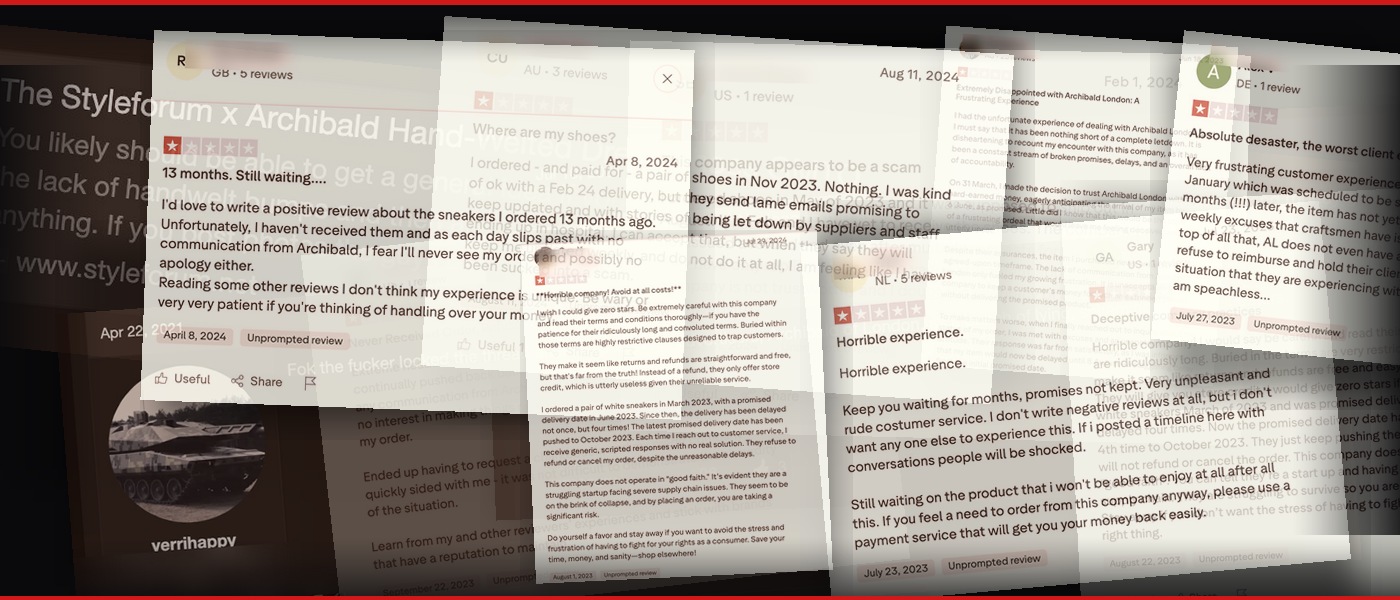
What followed was predictable. Negative reviews, screenshots, public posts to get attention — all stripped of context.
Once a narrative sets in online, it rarely updates itself. It hardens like cement. The reasons don’t matter as much as the outcome, and we’re not here to argue with that reality. We accept it.
As we said earlier, when people are unhappy, they are motivated to post about it. But when people are happy — or are made whole — they don’t always go back online to retract or correct former posts.
What changed, quietly
The most important changes weren’t visible from the outside.
Looking back, the factor that would have made the biggest difference in 2023 was simple: senior involvement before the problem became a crisis, not after. When timelines started slipping in 2022, Rohan was removed from the day-to-day. Decisions about what to tell customers, when to escalate issues, when to push back on suppliers — these moves were being made by people without the authority or the information to make necessary decisions appropriately and critically. Quickly. By the time things were bad enough for leadership intervention, things were very bad.
The second missing factor was face-to-face interaction. In the early years, regular visits to the workshops were part of how the business ran. Working trips, where someone sat with the craftsmen, understood what was actually happening in the schedule, and built the kind of relationship where truth was laid out before it became a problem. When the finances tightened, those trips stopped. The gaping hole left behind wasn’t just relational. It was informational. Archibald had been flying blind and didn’t fully realise it until Rohan was back in the room in Corridonia.
Everything else — the material buffers, the tighter pre-order minimums, the order visibility on the website, the reduction in SKU sprawl — those matter too. But they’re downstream of those two pivotal things above.
Fix the information flow and the human presence, make critical decisions quickly, and the rest becomes manageable.
Where we are now
When the dust settled, the pre-order model we had depended on had contracted around us. The negative reviews from 2023 were (and are) still there. And customers who received their shoes — whether on time or late — didn’t go online to let everyone know they actually got their product in the end.
The size of pre-order batches shrank by almost 80%. We had to take large credit risks in stock just to keep ticking along, exposing ourselves to the very situation we had tried to prevent.
Backed By You, responsible for new releases from Archibald, never took off. Which means new products — imagined and designed, ready to launch — were never made. The programme didn’t fail because the idea was wrong. It failed because we buried the pitch at the worst possible moment — when customer trust was already fragile, and we were asking people to commit to something new before we’d finished delivering something old. The customers who did participate understood exactly what they were part of. Most people never got the chance to find out.
If you knew where to look, the real signal we were in trouble wasn’t in the reviews. It was where everything else went quiet. The photography got worse — shot on an iPhone, not because we thought it was good enough, but because we didn’t have the resources to do better. The content stopped being generated. The storytelling across our website came to a halt. Advertising disappeared. That’s what a brand running on fumes actually looks like from the outside. Not a dramatic collapse. It looks like a gradual dimming and departure into the night as the lights go out.
We were still selling at Naked, still without the capital to invest in inventory. Pre-orders were the only momentum keeping us running — that, and a few loyal customers who continued to believe in what we were making. Because they knew we had damn good product for an unbeatable price.
What we refused to do was rush the membership programme that was always meant to underwrite everything else. The lifetime membership — Kakumei Dantai — had originally been slated for late 2023. We held it back. We audited the entire business first. Fixed the technical problems left behind by the previous team. Made absolutely certain that every product we were offering was ready. The irony is that by the time we launched in early 2025, we were simultaneously in the strongest position we’d ever been in terms of product quality and operational foundations — but we were still carrying the weight of everything that had come before and in the weakest position financially.
Kakumei Dantai wasn’t something we designed alone. It was created in genuine collaboration with one of our best customers — a titan in the business world with an insightful, experienced perspective — who believed in what Archibald was trying to do. He sat down and helped engineer a way for the Naked, at-cost model to persist and become something worth belonging to. A single lifetime payment. Permanent Naked pricing. Voting rights on products and direction. A community of people who didn’t just buy from Archibald but had a genuine stake in where it went.
We surveyed the customers closest to the brand before launch. The expressed interest was significant, but by the time it was ready, a fraction of them followed through with taking it. We understand why. The same period that made membership necessary had also made it harder to ask for trust. And the time in between blew by. Someone who had waited fourteen months for a pair of sneakers in 2023 wasn’t going to hand over $575 for a lifetime commitment without hesitation in 2025, even if everything they could see looking back told them the business had changed.
Later in 2025 we launched Rōnīn — designed specifically for customers who had shown interest in membership but moved on by the time it launched. An annual membership, $180 upfront, half the membership discount, upgradeable to Kakumei Dantai at any point. A way to experience what membership actually means before making the lifetime call. The ladder now exists: full price, Rōnīn, Kakumei Dantai.
Archibald still stands. Our product has never been better. The workshops are full of the right artisans. The materials and where we source them from are exceptional. Every customer who has committed to a pre-order has received what they paid for.
That’s the story nobody reads on the review platforms.
If you were affected by the delays between late 2022 and the end of 2024, your frustration is justified. We don’t expect forgiveness. We expect scrutiny. What we’re asking for now — the only thing — is for a chance. For your scrutiny to be applied to what we are now, not just what we were then.
We’re still here.
Whether you believe in us is up to you. But give us a chance to follow through and let you experience what we’re built around — our product, our craftsmen, our very human story of trial and error.
